Creative Suite
Director of Product Marketing | SteelHouse
Defining a New Model for How Digital Ads Are Created
Audience
Brand marketers, performance teams, and creative teams responsible for producing digital advertising, often working across multiple tools, relying on design resources, and constrained by slow, manual production workflows.
Goal
Launch a new product offering that simplified and centralized digital ad creation, while repositioning creative production from a fragmented, design-dependent process into a scalable capability owned by marketing teams.
The challenge was not just introducing a new set of tools, but shifting how teams approached creative production. Instead of treating it as a bottlenecked, resource-intensive process, the goal was to position it as something that could be faster, more iterative, and directly integrated into campaign execution.
Approach
1. Identified friction in the creative workflow
Grounded the narrative in a clear user problem: producing digital ads required multiple tools, handoffs between teams, and specialized skills, limiting speed, flexibility, and experimentation.
2. Positioned the product as an integrated system
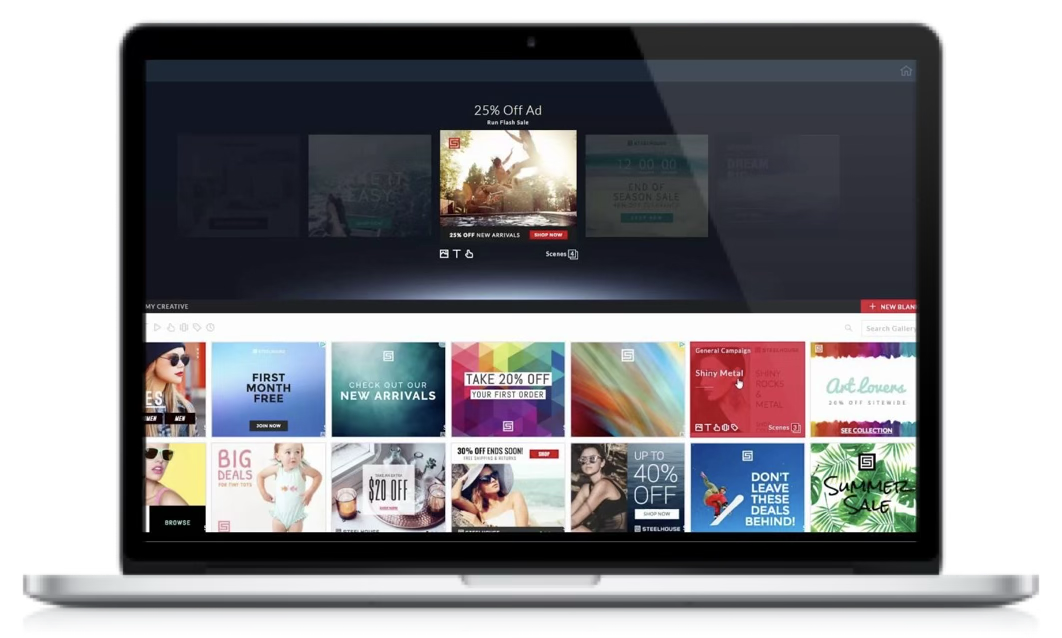
Reframed the offering as a unified platform combining ad creation, asset management, and deployment, allowing marketers to move from concept to live campaign within a single workflow.
3. Translated product capabilities into user outcomes
Connected features such as drag-and-drop creation, template libraries, and dynamic content integration to clear value: faster production cycles, reduced reliance on designers, and increased ability to test and iterate creative.
4. Built a narrative around accessibility and scale
Shifted messaging from individual features to a broader concept of democratizing ad creation, enabling marketing teams of varying skill levels to produce high-quality creative at scale.
5. Enabled go-to-market and sales adoption
Developed positioning and messaging frameworks used across sales and marketing to articulate the product’s value, helping teams introduce a new workflow and overcome skepticism around ease of use and output quality.
Impact
Established a clear product narrative that differentiated the offering from traditional design tools and fragmented ad tech workflows
Enabled sales teams to position the product as a productivity and performance unlock, not just a creative tool
Simplified how marketers understood and adopted creative production within the broader advertising stack
Supported the company’s expansion from media buying into a more integrated, end-to-end marketing platform
Repositioned creative production from a fragmented, design-dependent workflow into a unified, scalable system that marketing teams could own directly, enabling faster iteration and more effective advertising
Enabled enterprise sales teams with positioning, case studies, and demos that improved win rates by 15–20% and reduced sales cycles by 10–15%